

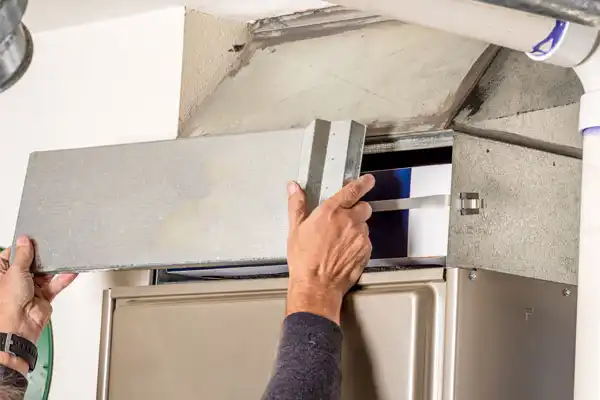
There’s a specific week every fall in the Roanoke Valley where the weather finally turns. The mornings get sharp, the Blue Ridge starts showing color, and one night you give in and bump the thermostat over to heat for the first time since March. That first burn is the moment a dirty filter stops feeling like such a small thing.
Southern Trust Home Services has been Roanoke’s trusted choice for over 30 years, and a surprising share of the no-heat calls we take in October and November trace back to something a homeowner could have handled in five simple minutes with a fresh filter. Here’s why the fall filter swap matters, and how to get it right.
Why Does a Furnace Filter Matter So Much in the Fall?
Your filter has one job, and it isn’t just cleaning the air. It protects the equipment behind it as well. Fall is when both of those jobs get harder at the same time.
- What happens to a filter over the summer? It keeps working even when the heat is off. Your blower runs during cooling season and shoulder season, pulling dust, pollen, and pet hair through the same filter for months. By late September, a filter installed in spring is usually loaded.
- Why is that worse once the heat comes on? A clogged filter restricts airflow, and a furnace needs steady airflow to run safely. Starved of air, the heat exchanger runs hotter than designed, the system short cycles, and the high limit switch starts shutting things down. That’s a no-heat call waiting to happen.
- Does a dirty filter cost money? Absolutely. Restricted airflow makes your furnace run longer to reach the same temperature, which shows up on your bill every month of the heating season. It also puts steady strain on the blower motor, and a blower motor is a real repair, not a cheap part off the shelf.
- What about the dust that already settled? Here’s the part that homeowners rarely connect. Your furnace and ductwork collected dust all summer while sitting idle. The first time the blower fires up for heat, some of that debris moves. A fresh filter catches it. A loaded one doesn’t.
How Do You Know When to Change Your Furnace Filter?
The interval printed on the filter package is a great starting point, not a rule. What actually matters is what your home puts through it.
- Hold it up to a light: If you can’t see light coming through the pleats, the filter is done. This is the fastest check there is and it doesn’t require knowing any technical knowledge.
- Check the color: A clean filter is white or off-white. Gray means restricted. Dark gray with visible fuzz means it’s been in there far too long.
- Watch for weak airflow at the vents: If rooms farthest from the furnace feel like they’re barely getting anything, a loaded filter is one of the first things to rule out.
- Notice how long the system runs: A furnace that continuously runs without satisfying the thermostat may be fighting for air.
- Factor in pets and allergies: Homes with dogs, cats, or anyone sensitive to dust should check monthly during heavy heating stretches rather than looking to the calendar.
- Account for recent projects: Sanding, remodeling, or new flooring puts enormous amounts of fine dust into circulation. Change the filter after the work wraps up, not on the usual schedule.
The habit worth building is simple. Check the filter when you pay the power bill, and swap it before the first genuinely cold night in Roanoke rather than after.
What Kind of Filter Should You Actually Buy?
This is where homeowners get talked into the wrong thing, usually by packaging. A higher number on the box isn’t necessarily better for your system. Filters are rated by how small a particle they trap. Denser filtration catches more, and it also makes air harder to pull through. Some residential systems handle a high-efficiency filter without any trouble. Others weren’t designed for that resistance, and putting one in creates the same airflow problem you were trying to avoid with a clean filter.
A few things that matter more than the rating:
- Get the size exactly right: Check the dimensions printed on the frame of the old one. A filter that’s even slightly small lets air slip around the edges, which defeats the whole purpose.
- Mind the airflow arrow: Every filter has an arrow on the frame, and it points toward the furnace. Installed backward, it still filters, just poorly and with added resistance.
- Match the filter to the system: If you’re unsure whether your furnace can handle a denser filter, just ask. Our technicians would be happy to tell you what your equipment is actually rated for, and we service almost all brands and ages of equipment, so this isn’t guesswork.
- Consider whether filtration is the real issue: If you’re chasing dust, allergies, or air that never feels clean, a filter alone may not solve it. An indoor air quality assessment looks at what’s actually in your air instead of leaving you cycling through filter brands.
Is a Filter Swap Enough, or Does the Furnace Need More?
Changing the furnace filter is the single best five minute task in home maintenance. But, it’s also important to understand that it can’t do everything.
A filter doesn’t clean burners, doesn’t check the heat exchanger for cracks, test the safety controls, or catch the failing part that’s going to quit in January. That’s what a tune-up is for, and fall is the window when scheduling one is still easy.
When our licensed technicians come out for furnace maintenance, they’ll inspect your system before heating season loads it up. Every technician has been background checked, certified, and insured, and we notify you in advance of arrival rather than handing you a vague window. They’ll explain all your options before starting any work so you’re making informed decisions, not approving something you don’t understand.
If a repair is needed, it’s backed by the Southern Trust Lifetime Repair Guarantee. When our experts recommend a repair, we guarantee it stays free from defects in materials and workmanship, under normal conditions, for as long as you own the home.
Swap the Filter, Then Let Us Handle the Rest
Go take a look at your filter. Right now, before the first cold night! If it’s gray, replace it, and you’ve already prevented the most common heating headache in the Roanoke Valley.
Then get the tune-up on the calendar while scheduling is still relaxed. Our Total Care Club membership keeps regular maintenance on a schedule so it stops being something you have to remember, and current heating specials are listed on our offers page.
Southern Trust Home Services proudly serves Roanoke, Salem, Vinton, Cave Spring, Blacksburg, Christiansburg, Bedford, Rocky Mount, Floyd, and communities throughout Amherst, Bedford, Botetourt, Campbell, Craig, Floyd, Franklin, Montgomery, Patrick, Pulaski, Roanoke, and Wythe counties. Call (540) 264-3890 or schedule your service online.
Recent Comments